

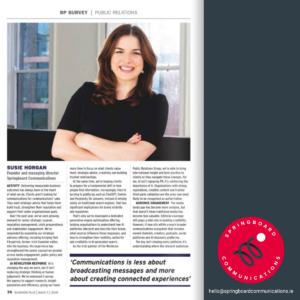
You may have seen our Founder and Managing Director, Susie Horgan, included in Business Plus this month. In her interview, Susie shares her perspective on the evolving role of PR – from the growing demand for senior strategic counsel and reputation management to the impact of AI on how organisations are discovered and understood.
Here’s her Q&A with Business Plus:
What have been your main areas of activity and growth over the past year? What services are most in demand by clients? What’s changed?
Delivering measurable business outcomes has always been at the heart of what we do. Clients aren’t looking for communications for communications’ sake. They want strategic advice that helps them build trust, strengthen their reputation and support their wider organisational goals.
Over the past year, we’ve seen growing demand for senior strategic counsel, reputation management, crisis preparedness and stakeholder engagement. We’ve responded by expanding our strategic advisory offering, including bringing former Irish Examiner Editor Tom Fitzpatrick into the business. His experience has strengthened the senior counsel we provide across media engagement, public policy and reputation management.
At the same time, AI has moved from being something businesses were curious about to something they know they need to understand. It’s changing how organisations are discovered and how reputations are formed. That’s why we’ve developed a dedicated Generative Engine Optimisation (GEO) offering, helping clients understand how AI platforms such as ChatGPT interpret their organisations, what sources shape those responses and what they can do to improve their visibility, credibility and authority.
The tools and technology will continue to evolve, but one thing hasn’t changed, organisations still need trusted advice, and communications that make a real difference to their business.
It’s been particularly rewarding to see that approach recognised by the industry. We were honoured to be named PRCA Agency of the Year 2026, our second consecutive win and third overall. The judges recognised our response to the AI, our investment and approach in our people and our focus on delivering measurable outcomes for clients. For us, it was a welcome endorsement of the direction we’ve taken as an agency and the value we’re delivering for our clients.
Can you comment on the increasing expectation from clients for PR to lead to tangible business growth?
Communications has always been about helping organisations achieve their wider objectives, whether that’s attracting the right talent, building trust with stakeholders, or supporting growth.
The best campaigns start with the business challenge, not the communications tactics. When you understand what success looks like from the outset, it’s much easier to measure the contribution communications can make.
One example for us was our recruitment campaign for a multinational advanced manufacturing company. The campaign contributed to a 50% increase in technical job applications and reduced recruitment timelines from nine months to three. That’s the kind of result clients are looking for, where communications is helping to solve a real business issue rather than simply generating coverage.
Outcomes matter more than outputs. Yes, media coverage still matters, but increasingly the conversation is about what changed as a result. Did we change behaviour? Did we improve perception? Did we help achieve the organisation’s objectives? Those are the measures that matter most.
How has your agency responded to the AI revolution and the challenge presented by generative engine optimisation?
AI is changing the way we work, but it isn’t replacing strategic thinking or human judgement. We’ve embraced it across the agency to support research, insight generation and efficiency, giving our team more time to focus on what clients value most: strategic advice, creativity and building trusted relationships. At the same time, we’re helping clients prepare for a fundamental shift in how people find information. Increasingly, they’re turning to platforms like ChatGPT, Gemini and Perplexity for answers instead of relying solely on traditional search engines. That has significant implications for brand visibility and reputation.
That’s why we’ve developed a dedicated Generative Engine Optimisation (GEO) offering, helping organisations understand how AI platforms interpret and describe their brand, what sources influence those responses, and how to strengthen their visibility, authority and credibility in AI-generated search.
As the Irish partner of the Worldcom Public Relations Group, we’re able to bring international insight and best practice to clients as they navigate these changes.
For me, AI isn’t replacing PR; it’s reinforcing the importance of it. Organisations with strong reputations, credible content and trusted third-party validation are the ones now most likely to be recognised as authoritative.
As the media landscape continues to fragment, how has your agency adapted in terms of engaging audiences? Has this meant a stronger focus on social media channels, podcasts, user-generated content etc?
The media landscape has become more complex, but that doesn’t mean traditional media has become less valuable.
Editorial coverage still plays a vital role in building credibility. However, it now sits within a much broader communications ecosystem that includes owned channels, creators, podcasts, social platforms, and AI discovery platforms.
The key isn’t chasing every platform; it’s understanding where the relevant audiences seek trusted information and ensuring organisations show up consistently across those touchpoints.
Communications today is less about broadcasting messages and more about creating connected experiences that reinforce reputation wherever people encounter your organisation.
Why is the role of PR so important now for brand perception and reputation and what have you observed in relation to ‘purposeful’ branding?
Brand perception has never been more important because people have more ways than ever to form an opinion about an organisation. They’re not just reading a news article or visiting a website. They’re seeing social content, asking AI platforms for information, reading Google reviews and hearing what others say. Reputation is built across all of those touchpoints.
That’s why PR has become a strategic business function rather than simply a communications discipline. It’s about helping organisations earn trust through credible stories, consistent messaging and meaningful engagement with the people who matter most.
Purpose matters and organisations can’t simply talk about their values; they have to demonstrate them. Increasingly, stakeholders expect businesses to back up what they say with action. As a B Corp-certified consultancy, we’ve seen first-hand how embedding purpose into the way a business operates strengthens trust with clients, employees and the wider community.
A good example is our work with a global food and ingredients business. Rather than simply promoting the business, we developed an integrated campaign that celebrated the people, innovation and sustainability behind it. By combining earned, owned and paid media, the campaign reached almost one million people on social media, generated more than 850,000
TikTok views and strengthened confidence in the sector among key stakeholders. We didn’t create a new brand story; but brought an existing and authentic one to life in a way that resonated with their audiences.
A version of this article appeared in Business Plus in August 2026.