Despite the important role media plays in our lives, most people still don’t understand what makes a story important to a journalist. That misunderstanding is prevalent when it comes to businesses or individuals wishing to secure a profile interview or media coverage.
It’s true that everyone has a story to tell. There are many types of stories, and the ones that connect with people the most often involve, simply, a story well told and told with authenticity.
There’s a reason why most newspapers opt for pictures of the people affected by budget spending decisions, rather than government ministers, on their front pages the morning after the Budget is published.
The story of the Budget could be anything. It could be tax cuts, house-buying incentives, the cost of a pack of cigarettes. But when we hear the story and its effect through our peers, it’s instantly more relatable.
A person who can tell you why the Budget has affected them, positively or negatively, is a far more compelling proposition for a journalist. The reader, listener, or viewer feels something, and is engaged as a result. It takes the audience beyond the complexity of the numbers, to the simplicity of the effect.
The human element of the story is vital.
Someone engaging with the media, particularly someone who hasn’t done so before, should remember this: A journalist is looking for something true, engaging, relevant and worth telling their audience. An interviewee may be focused on simply not getting into trouble live on air, remembering agreed messaging or getting to the end of an interview without making a mistake.
But unless interviewer and interviewee can meet in the middle, the result can be frustrating for everyone involved. A journalist must pitch their work to an editor. There’s nothing more frustrating, therefore, than coming away from an interview with no story to tell after putting in the time. The modern journalist is often thinking beyond the interview to the audience. Will subscribers want to read my 1,200-word interview with this person? If I give them airtime on our show, will people keep listening or will they switch channel to our competitor?
Media training can attract criticism, particularly when its cost becomes a news story. That scrutiny is understandable. Training is no good if it kills the part of the story that is human, authentic and attracted the journalist in the first place. But media training can be invaluable to someone choosing to tell their story.
Instead of thinking about what preparation costs, it’s worth thinking about not preparing and the cost that might have on a business.
A weak answer can damage confidence, distract from an important announcement or create an issue that did not previously exist. In a world where social media reports news quickly, and unfiltered, the consequences of a bad interview can be felt quickly. A short clip shared online can end up being discussed far beyond the original programme or publication.
Practice shouldn’t make an interview feel false. Saying something out loud can help you add weight to the points you specifically want to convey, by the time of the interview. By thinking about what you want to say and practising it, you reduce the risk of losing the reason for doing the interview in the first place.
Personality is important, and nerves can often obscure personality. The most effective spokespeople sound like themselves but come prepared to talk about the things that matter most. They’re informed, direct, authentic, and interesting as a result.
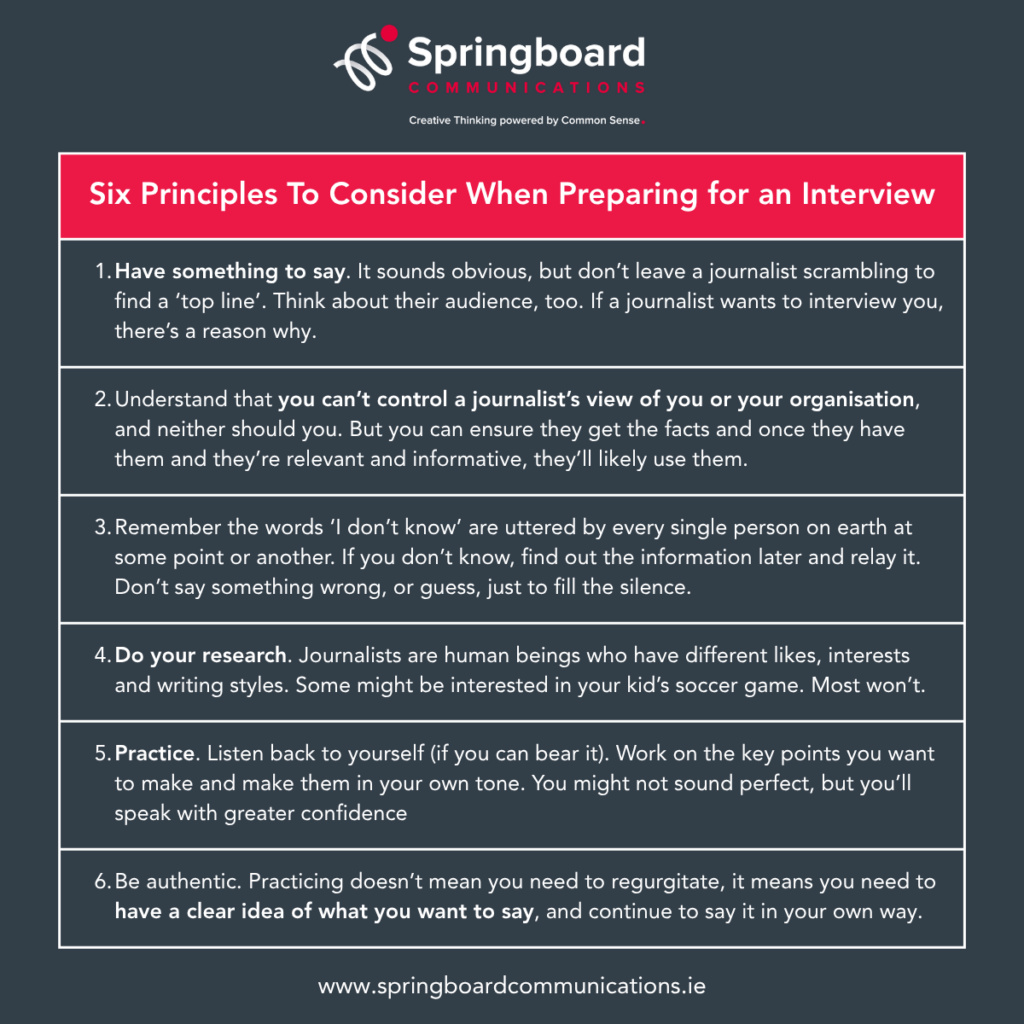
Here are six principles worth thinking about when preparing for an interview.
At Springboard Communications, we help organisations develop strategies that do more than fill channels with generic content. From thought leadership and executive profiling to digital communications and brand messaging, we work with clients to create content that is authentic, strategic and memorable. If you would like help telling your story, contact Tom Fitzpatrick at Tom@springboardcommunications.ie.